
Why Choose Plastic Tarpaulin for Your Business?

For businesses that move, store, or protect goods, the right covering can prevent avoidable damage. Plastic Tarpaulin is widely used because it is lightweight, water-resistant, and available in different thicknesses and sizes. A sheet can cover pallets in a loading area, shield equipment from rain, or separate dusty work zones. Small details matter: reinforced edges, securely placed eyelets, and suitable dimensions can make daily handling easier. A loose corner can catch wind. That matters.

Choosing a tarp is not simply a question of price. Buyers should consider how often it will be used, how long it will stay outdoors, and what it needs to protect. Sun exposure, sharp edges, and repeated folding may shorten its service life. Check product specifications rather than assuming every tarp offers the same tear strength or weather resistance. A heavier option may suit frequent outdoor use, while a lighter sheet can be easier to move and store. Still, it depends.

This article explores where plastic tarpaulins can support business operations, what features deserve attention, and how to compare options for a specific job. It also considers practical limits. No covering lasts indefinitely, and even a durable tarp can fail if it is badly secured or used beyond its intended purpose. Careful selection helps businesses balance protection, handling, and replacement costs without expecting one sheet to solve every problem.
Why Choose Plastic Tarpaulin for Your Business?

What Plastic Tarpaulins Are Made Of: PE, PVC, and Common Coatings

Why Choose Plastic Tarpaulin for Your Business?

Plastic tarpaulins commonly use polyethylene (PE) or polyvinyl chloride (PVC), but the base material is only part of the story. PE tarps often contain woven plastic strips sealed between thin laminated layers. They are light to carry and useful for covering pallets, equipment, or outdoor stock. Rain beads on the surface. Yet sharp corners can wear through the weave, and sun exposure may weaken material without suitable UV stabilizers.

PVC tarpaulins usually pair a polyester fabric mesh with PVC coatings on both sides. This construction tends to feel heavier and more flexible, with strong resistance to abrasion and repeated handling. Welded seams can help keep water out, though workmanship still matters. In cold weather, some PVC products stiffen; that detail is easy to overlook when choosing a tarp for year-round use.

Coatings shape how each tarp performs. PE laminations provide a practical moisture barrier, while PVC coatings can add durability and help create cleanable surfaces. Some products also use UV-resistant additives or specialized topcoats, but names alone do not guarantee performance. Check fabric weight, coating thickness, seam construction, and stated exposure limits. A tarp may look robust in a sample and still disappoint under constant wind or rubbing. That happens. Choose based on the actual load, weather, and handling conditions, and treat published specifications as useful evidence—not a promise that wear will never occur.

How 100–250 GSM PE Grades Suit Different Commercial Uses

Plastic tarpaulin works best when its weight matches the job. A 100 GSM PE sheet is light and easy to fold, making it useful for short-term dust covers, stall roofs, or protecting stock indoors. Around 150–180 GSM offers a practical middle ground for garden supplies, equipment, and routine delivery loads. For repeated outdoor handling, 200–250 GSM generally gives a sturdier feel and better resistance to snags. Still, GSM alone does not guarantee a long service life.

PlasticsEurope’s Plastics—The Fast Facts 2024 reports 413.8 million tonnes of plastics production worldwide in 2023. That figure shows the material’s broad industrial scale, not the performance of any particular tarp. For comparison, ISO 2286-2:2016 specifies how to determine the mass per unit area of coated fabrics, while ASTM D751-19(2023) includes tests for coated-fabric properties. A heavier sheet can still disappoint if its weave, seams, eyelets, or UV protection are weak.

Tips: Match the grade to handling frequency, not just price. Check GSM, seam finish, and UV-treatment details on the product sheet. Ask for test results when covering valuable goods. Measure the load first; an oversized tarp can flap hard in wind. A 250 GSM sheet is not automatically the right choice—sometimes it is simply heavier than the job needs.

How ASTM D882 Measures Tarpaulin Tensile Properties

Why Choose Plastic Tarpaulin for Your Business?

A tarpaulin may look tough, but appearance alone cannot show how much pulling force it can withstand. ASTM D882 measures tensile properties of thin plastic sheeting by pulling a prepared specimen in a testing machine. The test records the force and how far the material stretches before breaking. Results can help buyers compare samples and assess whether a sheet suits covers, temporary partitions, or packaging. Small details matter. Thickness, specimen preparation, test direction, and conditioning can affect the numbers.

For laminated tarpaulins, ask which layer or construction was tested. Some tarps contain woven reinforcement, so a thin-sheet method may not describe the finished product’s behavior fully. A reported tensile value is useful, but it is not a promise that a tarp will resist every tear, puncture, or gust of wind. I would check test reports alongside sample inspection and real-use requirements. That extra step can feel tedious.

Tips: Request results for both machine and cross directions when relevant. Compare samples tested under the same conditions, and check whether the report states thickness, elongation, and specimen details. If the product is woven or heavily reinforced, confirm that ASTM D882 is appropriate for that construction.

How ASTM G154 Evaluates Plastic Tarpaulin UV Resistance

Plastic tarpaulin can protect stock, equipment, and outdoor work areas, but sunlight gradually weakens some materials. ASTM G154 provides a controlled way to compare resistance to simulated sunlight and moisture. It uses fluorescent UV lamps, specified irradiance, and exposure cycles; it is a test practice, not a universal pass-or-fail rating. Small differences matter.

One commonly used ASTM G154 cycle applies UVA-340 light for eight hours at 60°C, followed by four hours of condensation at 50°C. The exact cycle and settings should appear in the laboratory report, since results depend on the chosen conditions. After exposure, compare tensile strength and elongation using ASTM D882, alongside visible changes such as cracking, fading, or brittleness. A tarp that still looks bright may have lost strength. That is easy to miss.

Tips: Ask for the full test schedule, exposure duration, and before-and-after measurements. Compare samples tested under the same conditions. ASTM G154 results help rank materials, but accelerated exposure cannot perfectly reproduce every outdoor climate. Reflect on the actual job: a tarp stored in intense sun needs different evidence than one used briefly under shade.

Why Choose Plastic Tarpaulin for Your Business? - How ASTM G154 Evaluates Plastic Tarpaulin UV Resistance

ASTM G154 is a practice for exposing nonmetallic materials to fluorescent UV light and moisture in a laboratory. The reference below summarizes test-planning factors; it does not report product test results or establish a universal pass/fail limit.

Evaluation dimension ASTM G154 test detail What to record for a tarpaulin Business relevance
UV lamp type The practice uses fluorescent UV lamps. UVA-340 lamps are commonly selected to simulate the short-wavelength UV portion of sunlight; the lamp type should be stated in the test report. Lamp type, specimen orientation, and the test setup used. Helps buyers compare test reports made under comparable exposure conditions.
UV exposure and moisture cycle A commonly used Cycle 1 sequence is 8 hours of UV exposure followed by 4 hours of condensation. The cycle and its settings must be specified; other procedures may be used. Cycle number, UV and moisture durations, and any departures from the selected procedure. UV plus moisture exposure offers a controlled way to examine weathering-related changes.
Exposure temperature For the commonly used Cycle 1 sequence, the UV step is typically controlled at a 60 °C black-panel temperature and the condensation step at 50 °C. Check the applicable standard edition and laboratory procedure. Temperature setpoints, control method, and total exposure time. Makes laboratory conditions transparent; accelerated exposure is not a direct conversion to outdoor service years.
Irradiance setting Irradiance is controlled at a selected wavelength when the apparatus and procedure call for it. A commonly specified UVA-340 setting is 0.89 W/(m²·nm) at 340 nm; the chosen setting should be reported. Wavelength, irradiance setpoint, and calibration or control details. Allows meaningful comparison only when the exposure settings are also comparable.
Physical appearance ASTM G154 specifies exposure conditions, not a universal visual rating or acceptance threshold. Inspect specimens before and after exposure using documented criteria. Color change, surface chalking, cracking, embrittlement, or other visible changes; include photographs and a stated rating method where used. Appearance matters where the cover remains visible or weathering could affect handling.
Mechanical-property retention Measure relevant properties before and after exposure using a separately selected, appropriate test method. ASTM G154 itself does not prescribe a universal tensile-retention requirement. Breaking strength, elongation, or another specified property, with specimen direction, conditioning, method, and results recorded. Helps assess whether the tarp can retain the performance needed for its intended use.
Test duration and acceptance criteria Choose exposure duration and pass/fail limits for the material and application before testing. ASTM G154 does not define a single required duration or universal pass/fail value for plastic tarpaulins. Total exposure hours or cycles, agreed acceptance limits, and all pre- and post-exposure measurements. A clear specification supports supplier evaluation without treating laboratory hours as guaranteed field lifespan.

Note: ASTM G154 is a laboratory exposure practice. Results depend on the selected lamp, cycle, irradiance, temperature, specimen, and assessment method; they should not be interpreted as a direct prediction of outdoor service life.

Where Waterproof, Reusable Tarpaulins Support Business Operations

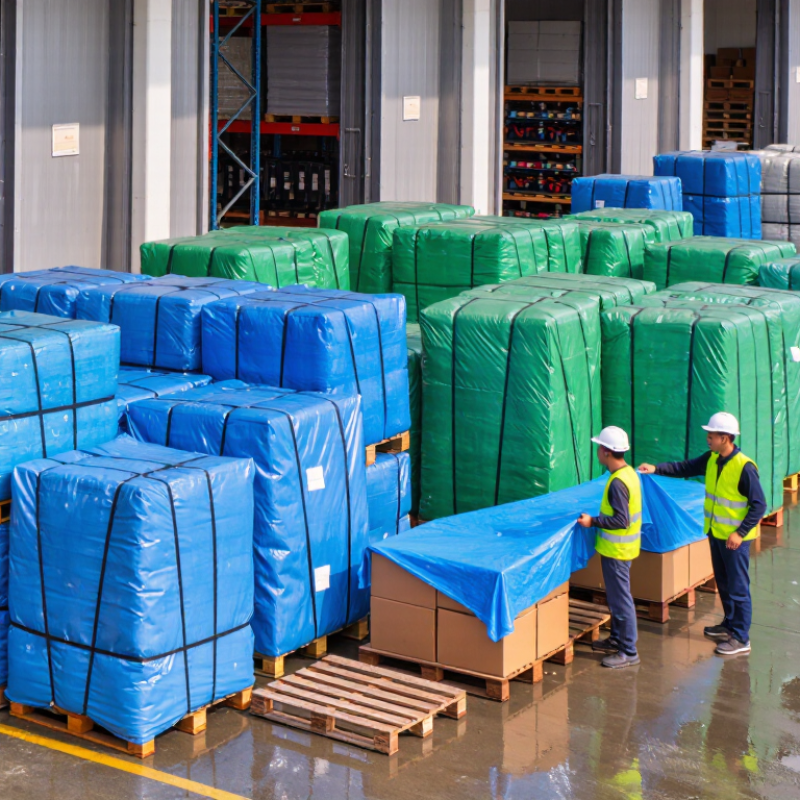
Plastic tarpaulins help businesses protect materials moving between indoor storage, loading bays, and outdoor work areas. A sheet over stacked cartons can shield them from passing showers and dusty wind during a delivery shift. Quick to unfold. Easy to reposition.

On a farm, a tarp can cover feed or equipment between uses. At a warehouse, staff may use one to protect goods temporarily while a loading area is busy. Reusable sheets can reduce the need for disposable covers, provided workers dry them before folding and store them away from sharp edges. Small habits matter. A torn corner can let water in, even when most of the sheet looks sound. For repeated use, check the fabric, eyelets, and seams regularly, and choose a size that can be secured without excessive strain.

Tarpaulins are useful, but they are not a fix for every storage problem. Covering damp goods tightly may trap moisture, so ventilation can matter as much as rain protection. That detail is easy to miss during a rushed shift. A practical setup leaves room for airflow and keeps the cover clear of hot surfaces or moving equipment. The best choice depends on exposure, handling frequency, and how long materials need protection.