What Are the Top 10 Thermal Break Types for Global Buyers?
Thermal Break systems are becoming a practical priority for architects, fabricators, and global buyers. The International Energy Agency reports that buildings consume about 30% of global final energy and produce roughly 26% of energy-related emissions. Small envelope details matter. A cold aluminum frame can form a visible condensation line beside warm indoor air.
The U.S. Department of Energy estimates that windows can account for 25%–30% of household heating and cooling energy use. This makes material selection more than a purchasing decision. It affects comfort, moisture control, operating costs, and product durability. Joseph Lstiburek, Ph.D., founder of Building Science Corporation, stated, “The best way to deal with thermal bridges is to eliminate them.” His principle remains useful, although real projects rarely achieve perfect continuity.
This guide examines ten Thermal Break types used across international construction markets. They include polyamide strips, PVC isolators, resin barriers, polyurethane systems, aerogel materials, cork, wood composites, structural thermal breaks, insulated glass edge systems, and hybrid solutions. Each type has different conductivity, fire behavior, weather resistance, processing requirements, and certification needs. Performance can change sharply after installation. A narrow gap, crushed strip, or missing seal may weaken the entire assembly.
There is no universal winner.
Buyers should compare declared thermal conductivity, tested U-values, dimensional stability, recycled content, and long-term supplier support. Reports from IEA, the U.S. Department of Energy, and European standards bodies provide valuable benchmarks. Still, laboratory results are not field reality. Regional climate, installation skill, and frame geometry must shape the final decision.
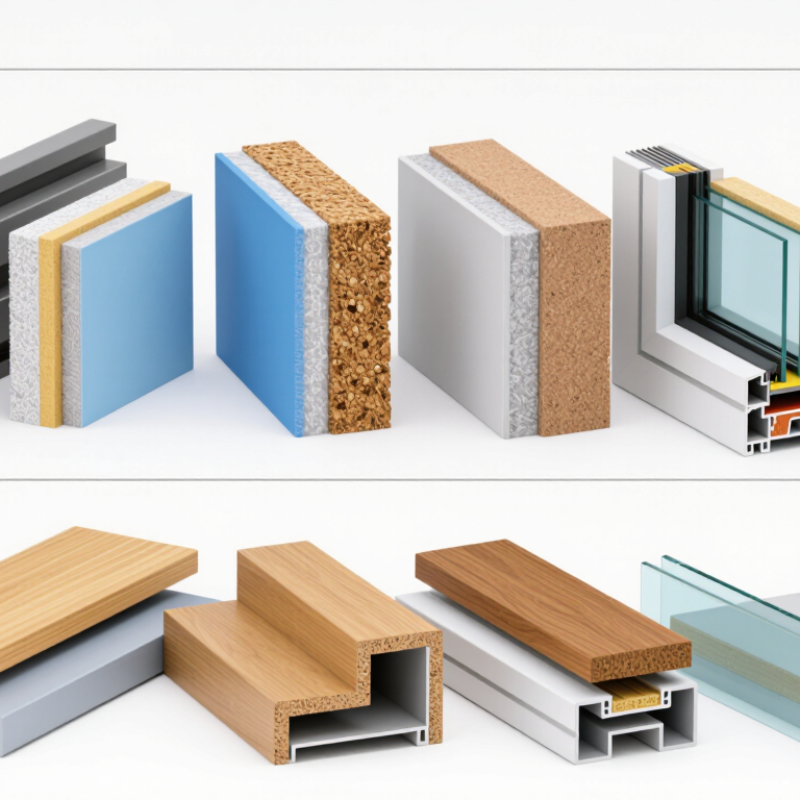
Thermal Breaks: Definition, Purpose, and Core Working Principles
Thermal Breaks: Definition, Purpose, and Core Working Principles
A thermal break is a low-conductivity material placed between conductive building components. It interrupts heat flow through metal frames, panels, balconies, and wall connections. Without this barrier, aluminum can carry outdoor cold directly indoors. Condensation may appear around the frame.
The working principle is simple. The break increases the thermal path and reduces thermal bridging. Common options include polyamide, polyurethane, PVC, EPDM, silicone, cork, aerogel, phenolic foam, fiberglass-reinforced polymer, and insulated stainless-steel connectors. Each type balances conductivity, strength, moisture resistance, fire performance, and cost. There is no universal winner. A material suitable for a window frame may fail in a balcony connector.
The International Energy Agency reports that buildings consume about 30% of global final energy. The U.S. Department of Energy also estimates that windows can contribute 25–30% of residential heating and cooling energy use. These figures explain why thermal breaks matter beyond comfort. Correct detailing can support lower heat loss and warmer interior surfaces. Yet product labels alone are insufficient. Installation gaps, fasteners, and wet insulation can reduce real performance.
Tips: Check the whole assembly, not only the insert. Request tested U-values, condensation analysis, and temperature limits. Review results under local humidity and wind conditions. Small errors matter. One overlooked metal screw can create a thermal shortcut. Load requirements may also change the preferred material.
How to Classify Thermal Break Types by Material and Structure
What Are the Top 10 Thermal Break Types for Global Buyers?
Global buyers can classify thermal break types through two lenses: material and structure. This approach supports clearer specification decisions. The ten common categories include reinforced polyamide strips, unreinforced polyamide strips, polyurethane pour-and-debridge systems, rigid PVC isolators, resin-based composite barriers, and aerogel-enhanced inserts. Polyamide often offers a practical balance between strength, heat resistance, and manufacturability. Polyurethane can fill complex cavities effectively. PVC remains useful where cost and profile flexibility matter, but its temperature limits require careful review.
Structural classification adds another layer. Single-chamber strips suit simpler profiles, while multi-chamber strips reduce heat transfer through longer internal paths. Cellular or honeycomb cores lower material weight and conductivity. Foam-core barriers can provide strong insulation, though compression and aging deserve attention. Continuous cast-in-place barriers create an uninterrupted insulating zone around difficult geometries. Hybrid systems combine a rigid carrier with a low-conductivity core.
The categories overlap. A multi-chamber profile may use reinforced polyamide or PVC. A supplier may name the same design differently. This division is useful, but imperfect. Buyers should verify thermal conductivity, profile geometry, moisture absorption, fire behavior, UV stability, and long-term dimensional change. Laboratory results can also differ from installed performance. Ask for test conditions, not only headline U-values. Small gaps, poor drainage, or incorrect assembly can weaken an otherwise excellent thermal break. Field experience shows that compatibility with coatings, sealants, fasteners, and glazing systems deserves equal attention.
What Are the Top 10 Thermal Break Types for Global Buyers?
Thermal break types can be classified by both material and structure. The chart compares representative thermal conductivity values for ten widely used insulation and profile materials. Lower λ values generally indicate better insulation performance.
Classification: polymer profiles include polyamide and uPVC; rigid boards include polyurethane, PIR, phenolic foam, EPS, XPS, mineral wool, and cork; flexible insulation includes aerogel blankets. Values are representative nominal thermal conductivity figures in W/m·K at approximately 23°C. Actual performance varies with density, moisture, temperature, aging, joints, and installation quality.
The Top 10 Thermal Break Types for Global Buyers
The Top 10 Thermal Break Types for Global Buyers include polyamide strips, polyurethane cores, PVC barriers, epoxy resin inserts, and fiberglass-reinforced polymers. Aerogel, cork, rubber, structural foam, and thermally broken steel systems complete the list. Each type interrupts heat flow between inner and outer frame sections. The choice depends on climate, loading, fire performance, and fabrication methods.
The U.S. Department of Energy reports that windows can contribute 25–30% of residential heating and cooling energy use. This makes frame design commercially important.
Polyamide and polyurethane suit high-volume aluminum systems, while fiberglass-reinforced polymers offer strong dimensional stability. Aerogel provides very low conductivity, but its cost and processing limits wider adoption.
Cork and rubber may work in specialized assemblies, although long-term compression needs careful testing. PVC and structural foam can support economical designs with moderate structural demands.
Numbers need context.
ISO 10077-2 and NFRC 100 calculations show that thermal-break performance depends on geometry, contacts, and installation. A low-conductivity insert cannot rescue a poorly sealed frame.
I would also question rankings based only on laboratory conductivity. Real buildings face wind, moisture, tolerances, and repeated temperature cycles.
The International Energy Agency continues to identify building-envelope efficiency as a major energy-saving opportunity.
Global buyers should request tested U-values, condensation analysis, durability evidence, and project references before comparing prices. No single type wins everywhere.
How to Compare Thermal Performance, Durability, and Installation Needs
What Are the Top 10 Thermal Break Types for Global Buyers?
When comparing thermal breaks, buyers should examine more than conductivity values. The ten common options include polyamide strips, poured polyurethane, reinforced nylon, PVC profiles, epoxy resin spacers, cork sheets, aerogel blankets, fiberglass composites, insulated steel separators, and structural foam blocks. Each interrupts heat flow differently. Polyamide and reinforced nylon suit many framed systems because they combine low conductivity with practical machining. Poured polyurethane can fill complex cavities, but installation quality affects its final performance. Aerogel performs exceptionally well in thin spaces, although its cost and handling requirements deserve careful review.
Durability must match the building environment. PVC may resist moisture, yet ultraviolet exposure and temperature cycling can change its long-term behavior. Cork offers renewable content and useful insulation, but compression and water management need attention. Fiberglass composites provide strength where loads are significant. Insulated steel separators can support demanding connections, though metal paths may create thermal bridges if the design is incomplete. Request tested U-values, thermal conductivity data, moisture resistance, fire classifications, and dimensional tolerances. Laboratory figures are useful. They are not the whole installation.
Installation needs often decide the real result. Check whether the break requires clips, adhesives, factory insertion, or on-site pouring. Review cutting tolerances and compatibility with sealants, coatings, and fasteners. A poorly fitted high-performance material can underperform a simpler one. That is easy to overlook. Site teams should inspect gaps, compression, alignment, and damaged sections before closing the assembly. I would also question unclear test conditions, because declared performance can vary with thickness, joints, and climate. Local codes and installer training may matter as much as the material itself.
How Global Buyers Can Select the Right Thermal Break Solution
What Are the Top 10 Thermal Break Types for Global Buyers?
Global buyers should select thermal breaks by climate, frame design, and compliance needs, not by material popularity. Common options include polyamide, polyurethane, PVC, epoxy resin, structural foam, aerogel, cork, mineral-based composites, insulated spacers, and hybrid inserts. Polyamide suits many aluminum systems because it combines low conductivity with practical processing. Aerogel performs strongly where space is limited, but its cost and handling requirements need careful review. The International Energy Agency reports that buildings consumed about 30% of global final energy in 2022. Small envelope improvements can therefore produce meaningful operational savings.
A reliable selection process starts with verified thermal data. Request tested U-values, ψ-values, dimensional tolerances, moisture resistance, fire behavior, and long-term aging results. The U.S. Department of Energy estimates that windows can cause 25–30% of residential heating and cooling energy use. This makes frame junctions important, not decorative. Check whether the thermal break matches the glazing, sealants, fasteners, and local fabrication equipment. Regional standards also matter, including ISO 10077 calculations and EN 14024 requirements where applicable. A low conductivity value alone can mislead. Poor installation may erase laboratory gains. Buyers should compare whole-window performance, warranty evidence, and production consistency. I would also test a sample in the target climate before approving large volumes. It costs time, but specifications are sometimes optimistic.