
China Top 10 Folding Glass Doors Manufacturers
China’s folding glass door industry has moved beyond basic aluminum frames and decorative panels. Many manufacturers now produce systems for villas, hotels, restaurants, offices, and coastal residences. The best suppliers combine precise fabrication, tested hardware, dependable seals, and responsive technical support.
As NanaWall founder Nana Wall observed, “The success of a folding door is in the details.” This principle remains highly relevant when evaluating China’s Top 10 Folding Glass Doors Manufacturers. A smooth showroom demonstration means little if rollers jam after repeated use, drainage fails during heavy rain, or the frame twists during installation.
This guide examines manufacturers through practical evidence. It considers product engineering, glass options, thermal performance, wind resistance, opening sizes, finish quality, production capacity, certifications, and export experience. It also looks at less visible factors, including replacement parts, installation guidance, packaging, and warranty communication.
Small details matter.
Manufacturers may offer similar brochures, yet their real capabilities can differ sharply. Some provide impressive customization but limited testing records. Others deliver strong factory quality but weak overseas service. That difference deserves attention.
The ranking is not absolute. Project location, climate, budget, and architectural design can change the best choice. Buyers should request current test reports, installation drawings, sample sections, and references from completed projects. They should also inspect corner joints, locking points, drainage channels, and glass specifications before signing a contract.
A perfect supplier does not exist. Careful comparison reduces avoidable risk.
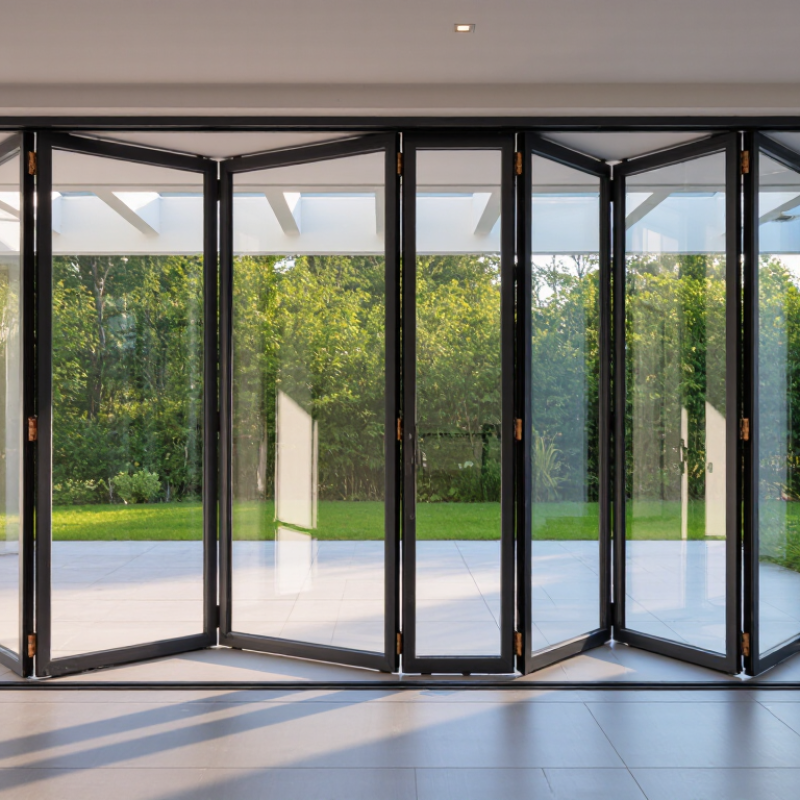
China’s Folding Glass Door Manufacturing Landscape
China Top 10 Folding Glass Doors Manufacturers
China’s folding glass door manufacturing landscape combines large production zones, specialized workshops, and export-focused factories. Many manufacturers serve hotels, villas, restaurants, offices, and retail interiors. Their product ranges often include aluminum folding systems, thermally broken frames, laminated glass, and insulated glazing.
Production usually begins with profile cutting, CNC machining, surface finishing, and glass processing. Skilled factories inspect corner joints, roller movement, drainage paths, and locking points. These details matter on busy entrances. A door may look elegant but perform poorly if the panels sag after repeated use.
Factory capability varies widely. Some manufacturers offer engineering drawings, site measurements, and sample testing before mass production. Others mainly follow standard designs and compete on price. Buyers should review glass specifications, hardware load ratings, wind resistance, water control, and installation guidance. Ask for practical test records, not only attractive photographs.
Small details reveal experience. Smooth rollers help in restaurants where doors open constantly. Narrow sightlines suit modern residences, while stronger frames support larger openings. Still, no supplier is perfect. Delivery delays, color differences, and unclear installation responsibilities can create avoidable problems. A reliable evaluation should compare factory inspections, communication quality, warranty terms, and after-sales response across the leading ten manufacturers.
China Top 10 Folding Glass Doors Manufacturers - China’s Folding Glass Door Manufacturing Landscape
The table below summarizes ten common manufacturer capability profiles within China’s folding glass door sector. Company names and brand-specific information are intentionally excluded. Product dimensions and configurations are representative specifications commonly available in the Chinese market and should be confirmed against individual technical drawings.
| Rank | Anonymized Manufacturer Profile | Typical Product Focus | Common Glass Configuration | Typical System Capacity | Common Frame Materials | Primary Applications | Relevant Standards and Tests |
|---|---|---|---|---|---|---|---|
| 1 | Large-scale architectural systems | Multi-panel top-hung folding doors | Tempered safety glass, commonly 8–12 mm | Panel widths approximately 600–1,200 mm; system heights up to about 3,000 mm, subject to hardware limits | 6063-series aluminum alloy with powder-coated or anodized finishes | Hotels, commercial entrances, showrooms, restaurants | Safety glazing requirements, EN 12150, EN 12100, ASTM C1048 where applicable |
| 2 | Thermal-performance door systems | Insulated folding glass doors | Double glazing, often 5 mm + 12A/16A + 5 mm | Improved thermal and acoustic performance; configuration depends on spacer and seal design | Thermally broken aluminum profiles with EPDM seals | Residential extensions, balconies, sunrooms, low-energy buildings | EN 14351-1, ISO 10077, air-water-wind performance testing where required |
| 3 | Frameless visual-opening systems | Minimal-frame or frameless folding panels | Tempered or laminated safety glass, commonly 8–10 mm | High clear-opening ratio; panel size is restricted by glass weight and roller capacity | Anodized aluminum tracks, stainless-steel fittings, silicone or EPDM seals | Cafés, terraces, retail interiors, hospitality projects | Applicable safety-glazing regulations and project-specific load testing |
| 4 | Weather-resistant balcony systems | Exterior folding balcony doors | Single tempered glass or laminated glass for enhanced safety | Multi-panel layouts with drainage channels and compression seals | Powder-coated aluminum, stainless-steel rollers and hinges | Balconies, patios, coastal residences, outdoor dining areas | Water penetration, air permeability and wind-load tests based on destination-market requirements |
| 5 | Commercial partition specialists | Interior folding glass partitions | Clear tempered glass, laminated glass or acoustic laminated glass | Light-to-medium duty systems designed for frequent opening cycles | Aluminum head tracks with slim vertical stiles | Offices, conference rooms, exhibition halls, retail stores | Impact-safety glazing, cycle testing and acoustic performance testing where specified |
| 6 | Heavy-duty entrance systems | High-cycle commercial folding doors | Laminated or tempered laminated glass for enhanced retention after breakage | Reinforced rollers, hinges and floor guides for frequent daily use | Reinforced aluminum profiles and stainless-steel hardware | Shopping centers, public buildings, transport facilities | Operational-cycle testing, safety-glass standards and accessibility requirements |
| 7 | Custom-design project fabricators | Made-to-measure folding door assemblies | Clear, tinted, low-iron, frosted, laminated or patterned glass | Project-specific dimensions, opening directions, panel counts and hardware layouts | Aluminum profiles with optional stainless-steel or brass accessories | Luxury residences, villas, bespoke hospitality interiors | Approved shop drawings, glass certification and project inspection records |
| 8 | Energy-efficient residential systems | Thermal-break residential folding doors | Insulating glass units with optional low-emissivity coating | Designed for reduced heat transfer and improved occupant comfort | Thermally broken aluminum with multi-point locking options | Houses, apartments, garden rooms and residential renovations | U-value calculations, condensation assessment and regional building-code compliance |
| 9 | Export-oriented modular suppliers | Knock-down and container-optimized door packages | Tempered, laminated or insulated glass selected for destination markets | Standardized modules, labeled components and installation documentation | Powder-coated aluminum with corrosion-resistant hardware options | Overseas residential and commercial construction projects | Destination-country labeling, packing inspection and required conformity documents |
| 10 | Value-focused standard-system producers | Standard-size residential and light-commercial doors | Clear tempered glass, commonly 6–10 mm | Predefined panel sizes, colors and opening configurations for shorter lead times | Standard aluminum profiles with powder-coated finishes | Home renovations, small shops, cafés and interior remodeling | Basic safety-glazing certification, dimensional inspection and functional testing |
Note: Actual maximum dimensions, glass thickness, wind-load ratings, thermal performance, hardware capacity and certifications vary by system design, installation conditions and destination-market regulations.