
How to Choose a Polyester Fiber Pillow Filling Machine
Choosing a Polyester Fiber Pillow Filling Machine is not just a matter of comparing prices or production speeds. The right equipment should match your fiber type, pillow sizes, output targets, and available floor space. A machine that performs well with soft, loose fiber may need different settings for recycled or denser material. Small details matter.
Start with the filling process. Check whether the machine opens and feeds fiber evenly, and ask how operators adjust filling weight for different pillow sizes. Uneven distribution can leave corners flat or create lumpy spots, even when the finished pillow looks full at first glance. Ask for a live demonstration using your own fiber, if possible. A short test can reveal more than a polished brochure.
Capacity matters, but advertised output figures may depend on material, operator skill, and product specifications. That is not enough. Compare practical production needs with the machine’s feeding system, controls, changeover time, and cleaning requirements. Review the electrical requirements and confirm that spare parts and technical support are available in your region. Request written specifications, warranty terms, and references from buyers running similar products. These checks help you assess claims without relying on sales language alone.
A careful choice also considers daily work. Can one operator load the fiber and monitor filling safely? Are routine adjustments clear, or do they require a technician? There may be trade-offs between higher output and flexibility for small batches. This guide explains the key features, questions, and checks that can help you select a Polyester Fiber Pillow Filling Machine suited to your actual production conditions.
Define Your Pillow Filling Requirements
How to Choose a Polyester Fiber Pillow Filling Machine
Define Your Pillow Filling Requirements
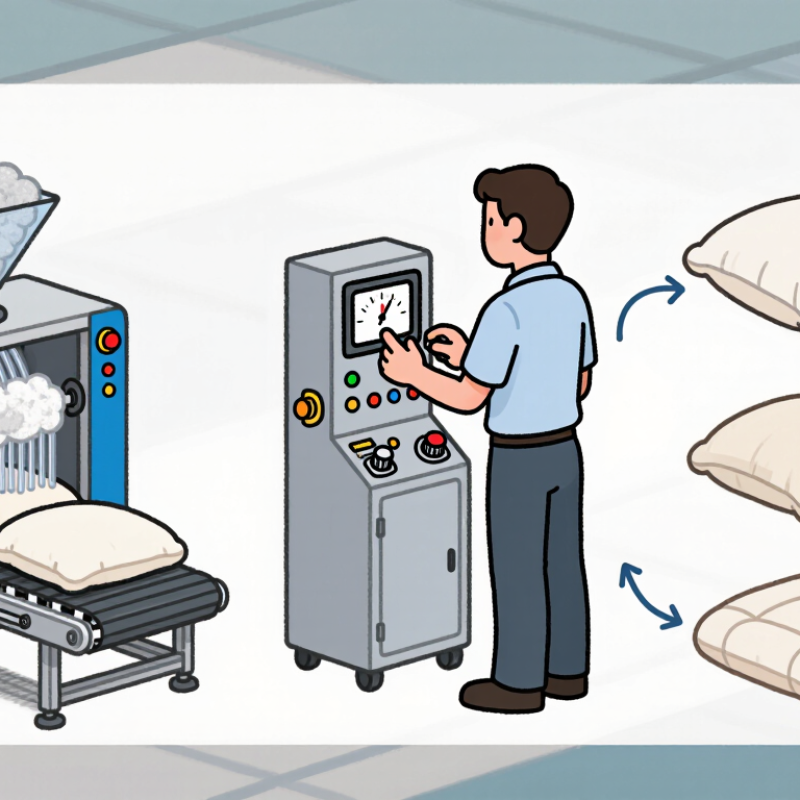
Start with the pillow, not the machine’s advertised speed. Record each product’s dimensions, target fill weight, fiber type, and expected hourly output. A 50 × 70 cm pillow may need a different fill setting from a compact cushion. Decide whether you will process virgin or recycled polyester, and whether the fiber is hollow, solid, or siliconized. These details affect feeding, opening, and weight control.
Scale matters. Textile Exchange’s Materials Market Report 2024 estimates that global fiber production reached 124 million tonnes in 2023, with polyester accounting for 57%. That figure shows polyester’s broad industrial use, but it does not tell you which machine fits your line. Test your actual fiber and pillow shell before deciding. Check fill-weight variation, fiber distribution, changeover time, and whether operators can clear blockages safely. A faster line is not always better; poorly opened fiber can leave hard spots. It is an easy detail to miss.
Compare Polyester Fiber Filling Machine Types
A manual or semi-automatic machine suits small workshops and frequent product changes. Operators can adjust fill by weighing each batch, but production depends on careful handling. It takes time. A pneumatic single-nozzle machine uses airflow to move opened polyester fiber into a pillow shell. It can fill faster, though pressure and feed rate need tuning to avoid uneven corners or excessive fiber compaction. Check that the hose and nozzle fit the pillow openings you use.
Multi-nozzle machines can fill several shells in a cycle, making them useful for repeat orders and higher output. Their setup may be less flexible when pillow sizes change. Integrated systems combine fiber opening, metering, and filling, reducing manual transfers between steps. They usually need more floor space and a clear maintenance plan. Compare actual output using your fiber grade and target pillow weight; catalog rates may not reflect your working conditions. Ask how operators clear jams and clean the feed path. A fast machine is not automatically the best choice. A modest system can be easier to calibrate, though that trade-off deserves a real production trial.
Evaluate Feeding Systems and Filling Accuracy
When evaluating a polyester fiber pillow filling machine, inspect how fiber moves from the opener or hopper to the filling outlet. A belt, screw, or air-assisted feeder may behave differently with slick, crimped, or blended fibers. Ask for a trial using your actual material, not just an easy-to-feed sample. Watch for bridging, clumps, and fibers collecting around the inlet. Small changes matter. A partly blocked feed can make one pillow dense and the next visibly flat. The cause may be upstream fiber preparation, not the filling head alone.
Check filling accuracy by weighing pillows from the start, middle, and end of a continuous run. Compare the results with your target weight and record the variation; one good sample proves little. Test different pillow sizes and fill levels, since a machine may stay precise on one setting but drift after adjustment. Ask how operators set feed rate, clear jams, and repeat a recipe after a shift change. The controls should make these steps clear. A simple calibration routine can be more useful than a crowded screen. Still, test it. Be cautious about accuracy figures without knowing their test conditions. Fiber moisture, static, and uneven opening can all affect delivery.
Assess Capacity, Controls, and Production Speed
A polyester fiber pillow filling machine should match your real shift output, not an optimistic brochure figure. Textile Exchange’s Materials Market Report 2024 estimates global fiber production reached 124 million tonnes in 2023, with polyester accounting for about 57%. That scale makes reliable, repeatable processing important. Still, global demand does not tell you which machine fits your factory.
Compare rated capacity in kilograms per hour with your daily target, then test the actual fiber blend and pillow size. Ask the supplier to run a timed trial using your material. Check whether the machine feeds evenly, keeps fill weights consistent, and handles short stops without clogging. Controls matter too: clear settings for airflow, feed rate, and filling time help operators reproduce results. Fast is not always better. Excessive speed can create uneven corners or require more rework. I would also allow room for a slower first week; setup rarely goes perfectly.
Tips: Record output, fill-weight variation, and downtime during the same trial. Request results for both light and dense pillow fills, and confirm which measurements are guaranteed. A simple checklist helps. Compare the tested figures with your own shift records before choosing.
| How to Choose a Polyester Fiber Pillow Filling Machine - Assess Capacity, Controls, and Production Speed | |||
|---|---|---|---|
| Selection Factor | What to Assess | Practical Check or Calculation | Why It Matters |
| Required capacity | Estimate the amount of polyester fiber filling needed per shift or day. | Divide the required daily output in kilograms by the planned production hours. For example, 160 kg over 8 production hours requires an average of 20 kg/h, before allowing for stoppages. | Matching machine capacity to actual demand helps avoid both production bottlenecks and unnecessary investment in excess capacity. |
| Output buffer | Allow for loading, material changes, cleaning, setup, and routine interruptions. | Compare the supplier’s stated output with your required average output, and ask for a production trial using your fiber and pillow design. A planning buffer may be appropriate, depending on operating conditions. | Published capacity may not equal sustained output in your facility. Fiber type, operator workflow, and product specifications can affect results. |
| Production speed | Check both filling rate in kg/h and finished pillows per hour. | Estimate pillows per hour as: kg/h × 1,000 ÷ filling weight in grams. At 20 kg/h and 500 g per pillow, the theoretical rate is 40 pillows/h, before downtime and handling. | A kg/h figure alone can be misleading when pillow sizes or fill weights differ. Confirm the rate using the intended product. |
| Fill-weight control | Review how the machine measures and controls the quantity of fiber delivered to each pillow. | Ask for the dosing method, adjustment range, and documented fill-weight variation from a trial run. Check results across multiple pillows, not just one. | Consistent fill weight supports product uniformity and helps control fiber use and finished-product quality. |
| Controls and operation | Assess the interface, recipe settings, speed adjustment, alarms, and operator access to key functions. | Confirm that operators can set and repeat the required filling parameters, and ask whether settings can be saved for different pillow styles. | Clear, repeatable controls can reduce setup errors when switching between products or production runs. |
| Fiber compatibility | Confirm that the machine handles the specific polyester fiber form and blend used in production. | Run a sample with your material. Check fiber feeding, opening, airflow, and whether the output is consistent throughout the trial. | Fiber properties and preparation can influence feeding behavior, filling consistency, and achievable production speed. |
| Production workflow | Consider how the machine fits with fiber storage, pillow-shell loading, filling, closing, and packing. | Map the process from fiber supply to finished pillow, and identify any manual steps that could limit the machine’s output. | The overall line rate depends on connected processes as well as the filling machine itself. |
| Maintenance and cleaning | Check access to areas that need inspection, cleaning, or routine service. | Request the maintenance schedule, cleaning instructions, common wear-part list, and expected replacement intervals. | Planned maintenance and accessible cleaning points support reliable operation and reduce avoidable downtime. |
| Acceptance testing | Define measurable performance requirements before purchase. | Agree on a test using the intended fiber and pillow specification; record output rate, fill-weight consistency, operating conditions, and any stoppages. | A documented test gives both parties a clear basis for comparing the machine’s performance with production needs. |
Check Safety Features, Maintenance, and Supplier Support
How to Choose a Polyester Fiber Pillow Filling Machine
Check Safety Features, Maintenance, and Supplier Support
A machine’s output matters, but safe access matters just as much. Check for fixed guards around moving parts, clearly marked emergency stops, and interlocks that stop operation when a guard opens. Ask how the machine handles fiber jams; clearing tangled material by hand should not be the routine answer. Small details matter. Look for dust-control connections, accessible isolation points, and clear instructions for shutdown and cleaning. A polished control screen alone does not prove a machine is well designed. I would want to see the safety functions demonstrated, not just listed on a specification sheet.
Maintenance affects both uptime and filling consistency. Ask how often belts, bearings, and cutting components need inspection, and whether operators can reach them without awkward lifting. A sample maintenance schedule is useful, but check that it matches your expected daily hours and fiber volume. Fiber can collect around feed rollers and sensors, so ask how those areas should be cleaned. The answer should be specific. Supplier support deserves the same scrutiny: confirm whether installation guidance, operator training, troubleshooting, and replacement parts are available. Ask how quickly support usually responds, and request the details in writing. One point is easy to miss: even a dependable machine can become frustrating if routine parts take weeks to arrive.
